Market Monitor is a modular data pipeline that collects product, offer, and pricing data across multiple marketplaces under real constraints: large catalogs (170k+ items), strict rate limits, and long-running scans.
The core design is atomic staging: each scan writes to staging tables and promotes only after validation. Dashboards always see a consistent dataset—either the previous snapshot or the new one, never a partial mix.
What it does
- Scans marketplaces via official APIs (and targeted scraping where needed)
- Normalizes data into a single PostgreSQL schema
- Tracks scan runs (start/end/fail), error counts, and quality metrics
- Uses concurrency + rate limiting to scale without getting blocked
- Promotes staging → production atomically per marketplace
Problem & constraints
The system needed to answer a simple business question (“what’s happening to our prices and offers across marketplaces?”) under hard engineering constraints:
- Huge catalog sizes (170k+ products per marketplace)
- Rate limits and intermittent API/network failures
- Long-running jobs (minutes to hours) that must not break reporting
- Different data shapes per marketplace (identifiers, offer models, inventory, shipping)
Key design decisions
- Atomic staging per marketplace: writes go to staging tables; promotion swaps in a complete snapshot.
- Marketplace isolation: each marketplace has its own client + processor, but shares the same pipeline contract.
- Scan tracking: every run records start/end/fail + outcome metrics so you can trend reliability over time.
- Progress + observability: periodic progress reporting for long scans (useful when running via automation).
- Safety controls: process locking prevents overlapping scans for the same job.
Tech Stack
| Domain | Tools & Libraries |
|---|---|
| Core Logic | Python 3.11+, Pandas (Dataframes), Threading (Concurrency) |
| Data Persistence | PostgreSQL, SQLAlchemy (ORM), Alembic |
| Integration | python-sp-api (Amazon), Custom REST Clients (Kaufland/Galaxus) |
| Scraping | SeleniumBase (Headless Browser), BeautifulSoup4 (HTML Parsing) |
| Infrastructure | n8n (Workflow Orchestration), Linux (Ubuntu) |
Production setup
This project runs in production for a client:
- Deployed on a self-hosted n8n instance on Linux
- Environment maintained by me (updates, Python runtime, dependencies)
- Scheduled scans monitored through workflow logs and scan tracking records
Automation & AI enrichment
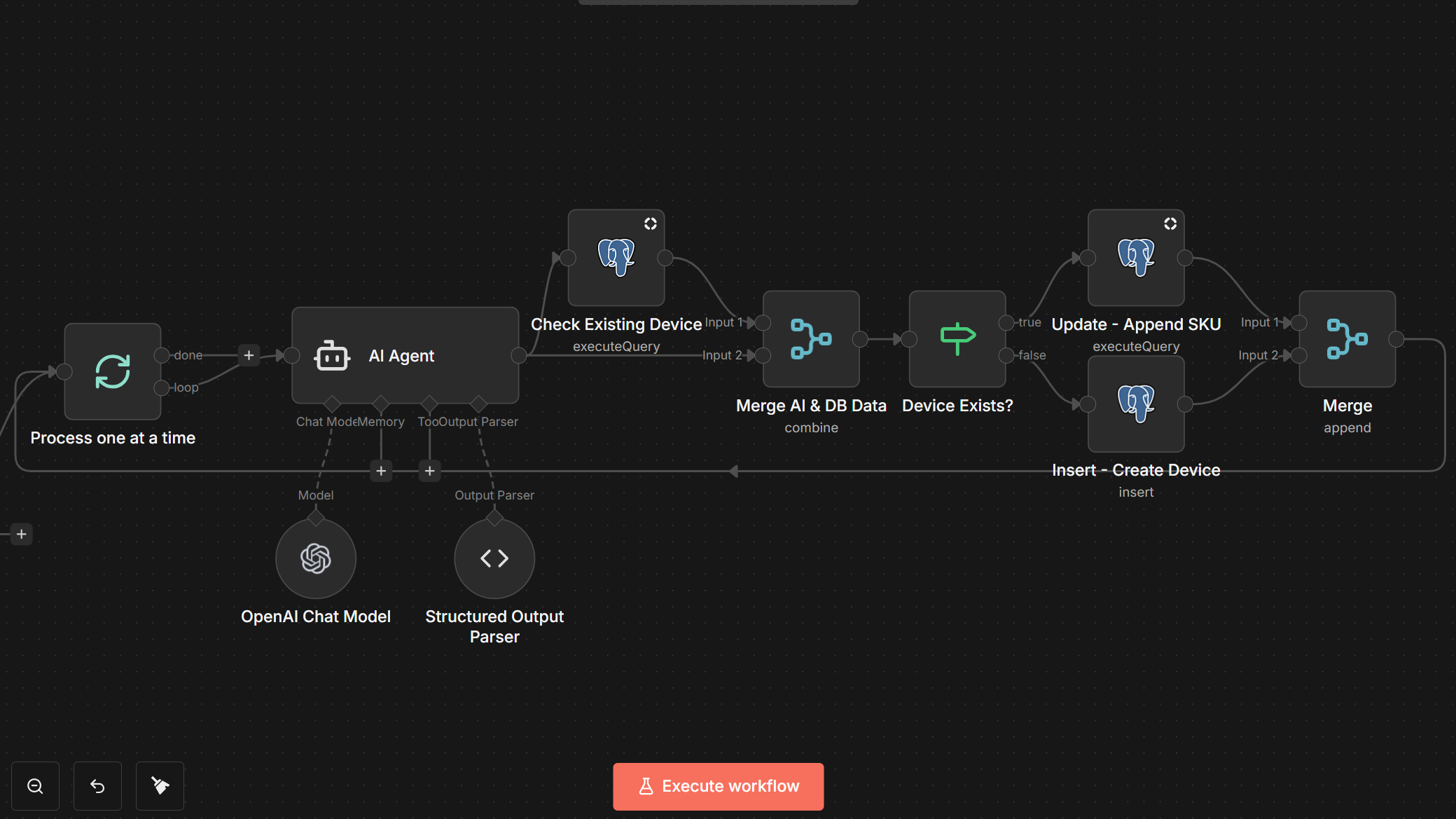
Some feeds are enriched through AI workflows in n8n:
- Ingests Amazon bestsellers/newcomers and Schutzfolie24 newcomers as trend signals
- Extracts structured attributes from noisy metadata (model, model numbers, device type)
- Enforces strict JSON outputs so downstream steps remain deterministic
Architecture overview
The pipeline is designed for fault tolerance. If a scan fails 90% of the way through, the bad data is discarded and production remains untouched (Atomic Staging).
graph TD
    Trigger[n8n Scheduler] -->|Start| Scanner[Python Scanner]
    Scanner -->|Fetch| API[Marketplace API]
    API -->|Data| Scanner
    Scanner -->|Write Batch| Staging[(Staging DB)]
    Staging -->|Validate| Checks{Post-Scan Checks}
    Checks -- Pass --> Swap[Atomic Promotion]
    Checks -- Fail --> Alert[Error Notification]
    Swap -->|Replace| Production[(Production DB)]
Scan Process Sequence
The entire process simulates a transactional update on a massive scale.
sequenceDiagram
    participant S as n8n Scheduler
    participant P as Python Scanner
    participant M as Marketplace API
    participant DB as Postgres DB (Staging)
    participant PROD as Postgres DB (Prod)

    S->>P: Trigger Scan (Cron)
    activate P
    P->>P: Acquire Process Lock File

    loop Concurrent Batch Processing
        P->>M: Fetch Inventory/Offers (w/ Rate Limit)
        M-->>P: Raw Data
        P->>P: Normalize & Enrich
        P->>DB: Bulk Insert (Staging)
    end

    P->>DB: Run Integrity Checks (Counts, Missing Items)

    alt Integrity Pass
        note over P, PROD: Atomic Promotion Phase
        P->>PROD: Begin Transaction
        P->>PROD: Swap Staging -> Active Schema
        P->>PROD: Commit
        P-->>S: Report Success (Metrics)
    else Integrity Fail
        P->>DB: Rollback / Discard Staging
        P-->>S: Alert Failure
    end

    deactivate P
Marketplaces (modules)
I present this as one project with multiple modules to highlight different engineering challenges: Scale (Monitoring) and Intelligence (Trend Detection).
1. Core Price Monitoring (Amazon, Kaufland, Galaxus)
Focus: High throughput, reliability, and data consistency.
These modules monitor the client’s massive catalog (170k+ items) to track price changes and competitor offers.
- Amazon Monitor: Uses the official SP-API to scan own and competitor listings. Matches products via GTIN/EAN to ensure catalog consistency.
- Kaufland Monitor: Handles multi-account management (ZenGlass, Dipos) within a single scan cycle. Uses aggressive threading (60+ workers) to handle the volume within acceptable windows.
- Galaxus Monitor: Marketplace-aware scanning (DE/CH) with strict process locking to prevent overlapping jobs.
Key constraint handled: Atomic staging ensures that even if a scan takes 2 hours, the pricing dashboard never shows a mix of “old” and “new” data.
2. AI-Powered Trend Detection (Schutzfolie24, Amazon Newcomers)
Focus: Unstructured data extraction and automation.
These modules detect new devices as soon as they appear in competitor feeds or bestseller lists.
- Flow:
- Python scraper collects raw newcomer/bestseller data.
- n8n sends records to an AI extraction step.
- AI returns strict JSON (
model,model_numbers,device_type). - Products are auto-tagged for faster filtering and prioritization.
3. Inventory Tooling (eBay)
- eBay Inventory: Handles bulk export and parsing of large XML seller lists (260k+ items) to audit listing status and shipping costs across international sites.
Engineering Highlights
- Self-healing process locks: Stale PID detection prevents blocked cron schedules after hard crashes.
- Workflow-friendly CLI behavior: Semantic exit codes (
0/1/2) and explicitstderrhandling improve n8n observability. - Scraper debugging hooks: Timestamped HTML dumps speed up diagnosis of anti-bot and layout-change failures.
- Smart caching + round-robin clients: Reduced API pressure with cached GTIN→ASIN lookups and thread-safe client rotation.
Performance
- Concurrency is used where safe (thread pools for IO-bound fetches)
- The DB write path is optimized around staging to reduce lock contention
- Long scans remain observable with periodic progress logs
Results (Production Metrics)
- Catalog Scale: Handled ~170k+ products per marketplace (Kaufland DE) and ~260k+ inventory items (eBay).
- Scan Durations:
- Kaufland: ~25 minutes for 170k items (Active Concurrency: 60 threads).
- Galaxus: ~5.7 hours (DE) to ~13 hours (CH) (throttled to respect strict anti-bot rate limits).
- Trend Scrapers: ~12 minutes end-to-end for daily newcomer detection.
- Throughput: Peaking at ~6,800 items/min on high-concurrency modules (Kaufland).
- Reliability: No failed scheduled runs observed in the last 30 days, supported by self-healing locks and automatic retries.
What I’d improve next
- Add a small web UI for scan history + anomaly charts
- Add idempotent “resume from last successful page” for specific marketplaces
- Centralize a shared validation suite across all marketplace modules